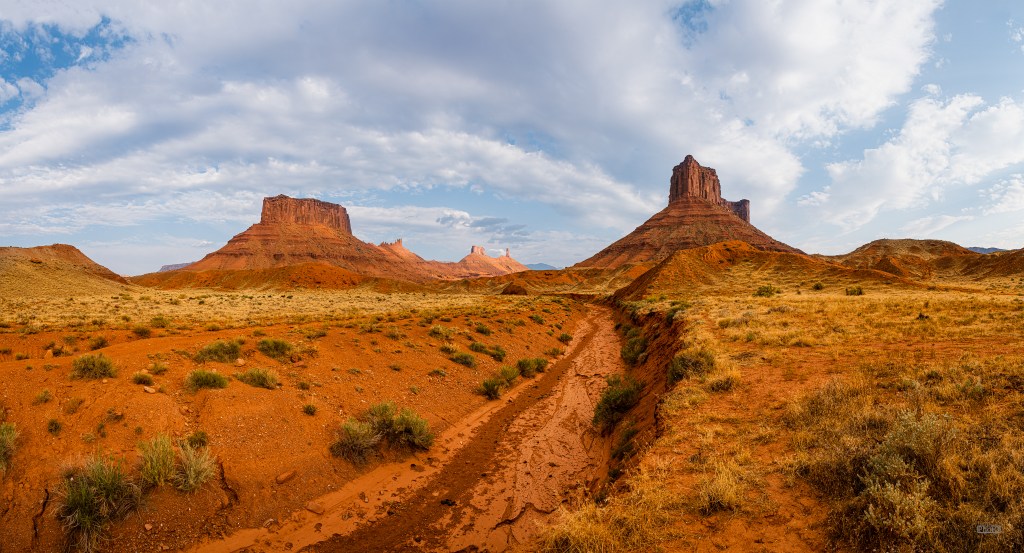
Moab is a town of about 5,000 people in southeastern Utah. It sits between Arches and Canyonlands National Parks, with state parks and Bureau of Land Management land in nearly every other direction. That makes it a practical base: trails and overlooks are close, while hotels and good, varied restaurants are available when the desert has supplied enough scenery for one day.
We photographed along the Colorado River, in Canyonlands, and at Dead Horse Point State Park. The distances are manageable by car, but the landscape changes with elevation and direction. River-level views are enclosed by sandstone walls; the higher overlooks reduce the same terrain to bends, shelves, and narrow bands of water.
Castleton Tower
Castleton Tower stands about ten miles northeast of Moab. The sandstone tower rises roughly 400 feet from the top of a 1,000-foot cone, so it remains visible well before the road reaches it.
For the photograph below, a pool of still water supplied a reflection of the tower. The 30-second exposure smoothed the surface and held detail in the darker foreground.
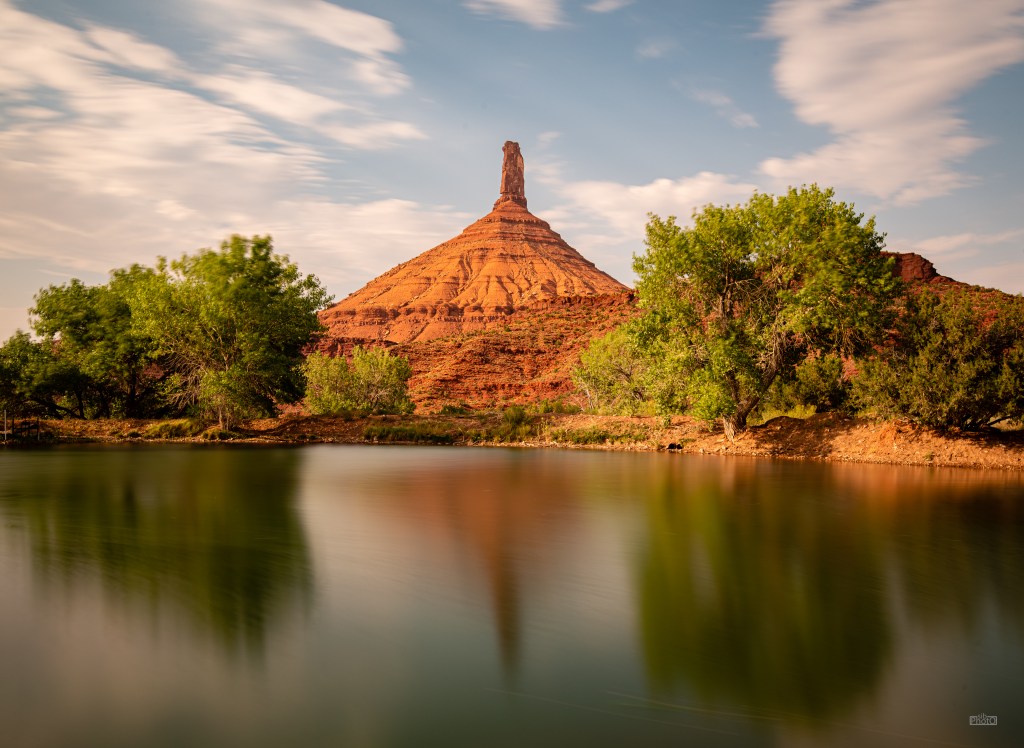
Thousands of climbers have reached the summit. In 1964, Chevrolet went a step further and placed an Impala on top for a television commercial. The car arrived by helicopter, which is one way to avoid the technical parts of the climb.
Along the Colorado River
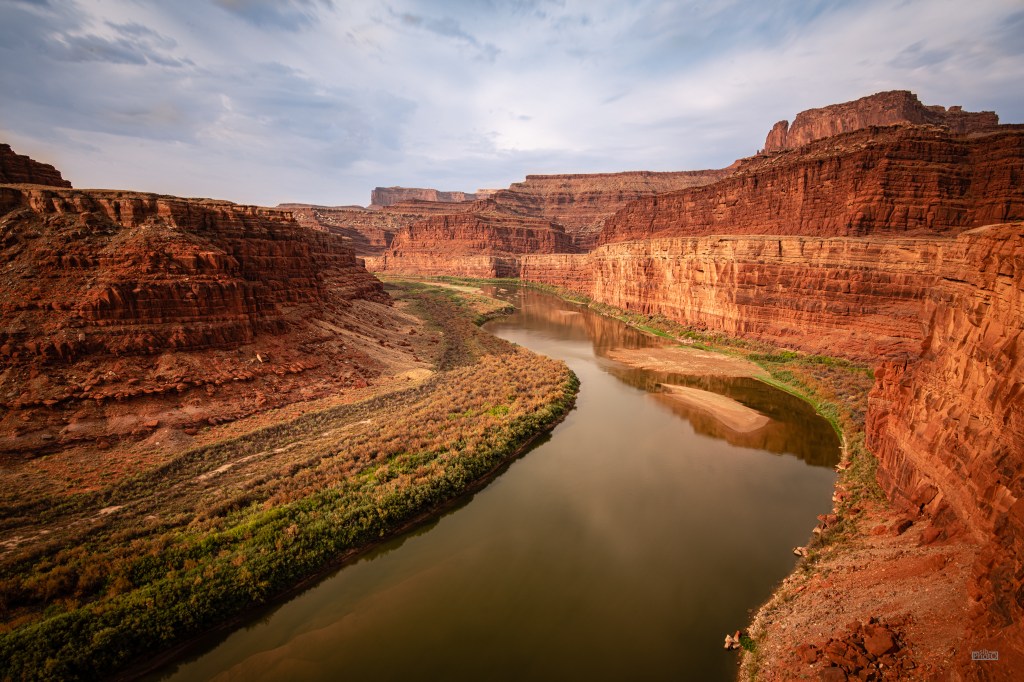
The Colorado River runs for more than 1,400 miles through seven U.S. states and Mexico. Around Moab, it passes between sandstone walls before joining the Green River in Canyonlands. The two rivers and their tributaries have cut much of the region’s present network of canyons.
At the Gooseneck downstream from Moab, a 20mm lens included the full bend and the rock rising on both sides. A 60-second exposure removed most of the texture from the water, leaving the river as a pale curve through the darker canyon.
Closer to the river, an isolated pool was drying in the sun. Its shallow water, sediment, and cracked edges made a smaller and less obvious subject than the main channel.
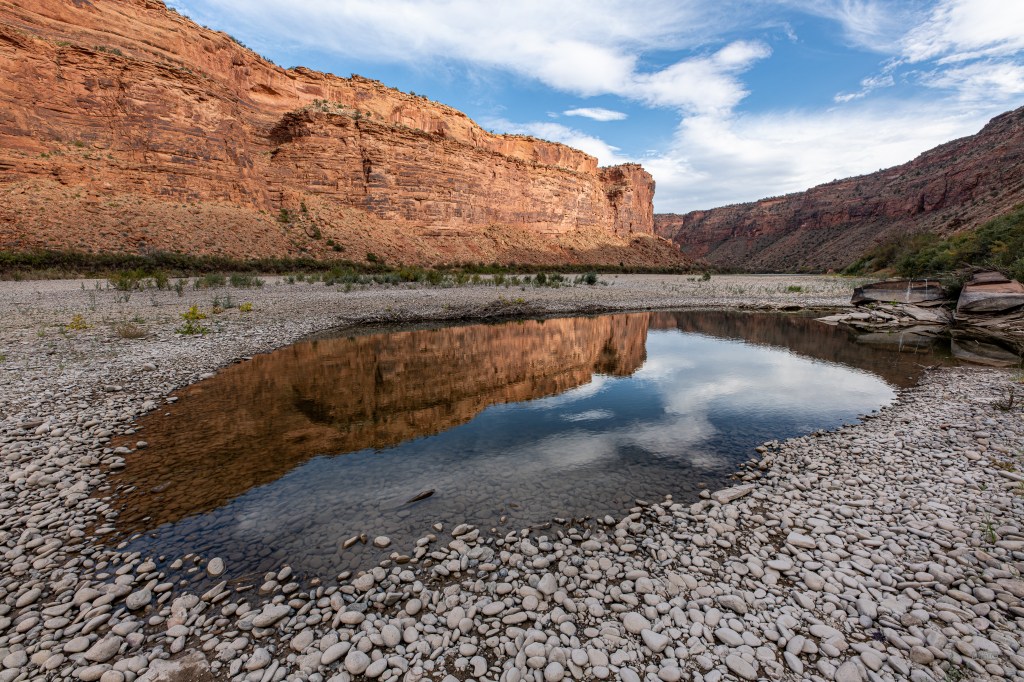
The river carries sediment downstream and leaves it behind on bars, beaches, and the margins of temporary pools. Those details are easy to miss from the overlooks, where the Colorado can look like a thin, orderly line.
Canyonlands National Park
Canyonlands covers more than 335,000 acres (135,000 hectares) in southeastern Utah. The park is divided into four districts, separated by the Colorado and Green rivers and the canyons around them. Traveling between districts usually requires returning to roads outside the park; features that appear close on a map may be hours apart by car.
The park contains mesas, arches, spires, and deeply cut drainages. Hiking, mountain biking, camping, and backcountry travel are all possible, although overnight trips require permits. Canyonlands is also designated as an International Dark Sky Park, which makes it a great place to practice your astrophotography.
Mesa Arch is one of the most recognizable foregrounds in the Island in the Sky district. From the standard viewpoint, the arch frames the canyon and distant rock formations rather than standing alone against the sky.
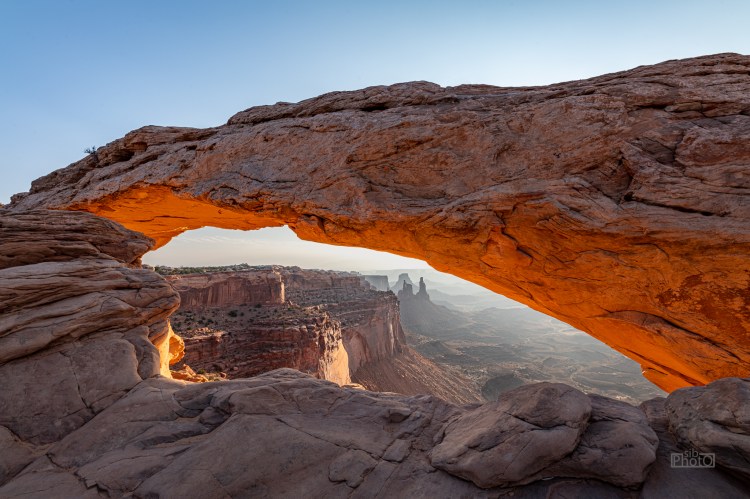
Nearby Arches National Park receives more attention, but the two parks ask for different kinds of photographs. Arches concentrates the eye on individual formations. Canyonlands is largely about scale, layers, and the problem of fitting a very large space into a rectangular frame.
Dead Horse Point
Dead Horse Point State Park covers more than 5,000 acres on a high plateau above the Colorado River and Canyonlands. Its name is associated with a story that cowboys used the narrow point as a natural corral for wild horses, some of which were later left without access to water.
The main overlook looks down on a broad river bend, with roads and terraces visible across the canyon. A 24mm lens was wide enough to include the bend while keeping the foreground rim in the frame.

The park has hiking and mountain-biking routes, campsites, scenic roads, and archaeological sites. It receives less attention than the two nearby national parks, although the overlook does not suffer by comparison. In almost any state with fewer famous neighbors, Dead Horse Point would probably have a much larger sign.


Leave a Reply